
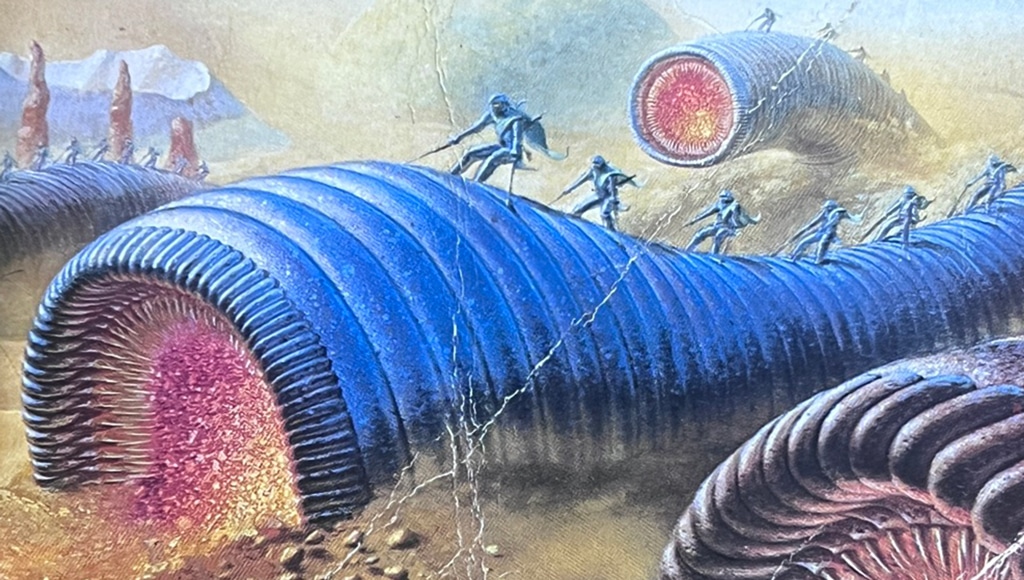
Dune
In the late 1950s, Frank Herbert became obsessed with sand.
He had traveled to Oregon to report on the government’s dune-stabilization experiments near Florence. What he found was a landscape in motion — waves of sand that swallowed roads, reshaped forests, and threatened towns. Herbert chartered a plane to see it from above, then spent six years turning those dunes into something larger: an entire universe. His notes grew into 215,000 words of dense world-building — ecological systems, invented religions, political intrigues, glossaries, even appendices.
Publishers balked. Between 1963 and 1965, the manuscript collected twenty-three rejections. Too long. Too complex. Too strange. Finally, Chilton Books, a Philadelphia house best known for auto-repair manuals, took a gamble. They paid Herbert $7,500 and printed 2,500 copies in 1965.
Sales were dismal. Sterling Lanier, the editor who had fought for it, lost his job.
But word spread. That first edition won the Hugo Award (shared with Roger Zelazny’s This Immortal) and the inaugural Nebula Award. Herbert, still working as a newspaper reporter, began drafting sequels. Slowly, Dune built its audience. Readers passed it hand to hand. Its world — a desert planet where water was wealth and ecology was destiny — felt eerily prescient.
The book that major publishers deemed unpublishable has since sold millions, translated into dozens of languages, and shaped half a century of science fiction. What began with one man staring at shifting sand became Dune — the best-selling science-fiction novel of all time.